
Market Niche
Market niche is a narrow area of business where the target audience is clearly defined and their needs are specific.

Key characteristics of a market niche:
- a narrow and well-defined target audience;
- specific customer needs;
- low competition or none at all;
- small market capacity (sales volume is limited due to the product's specificity and narrow demand).
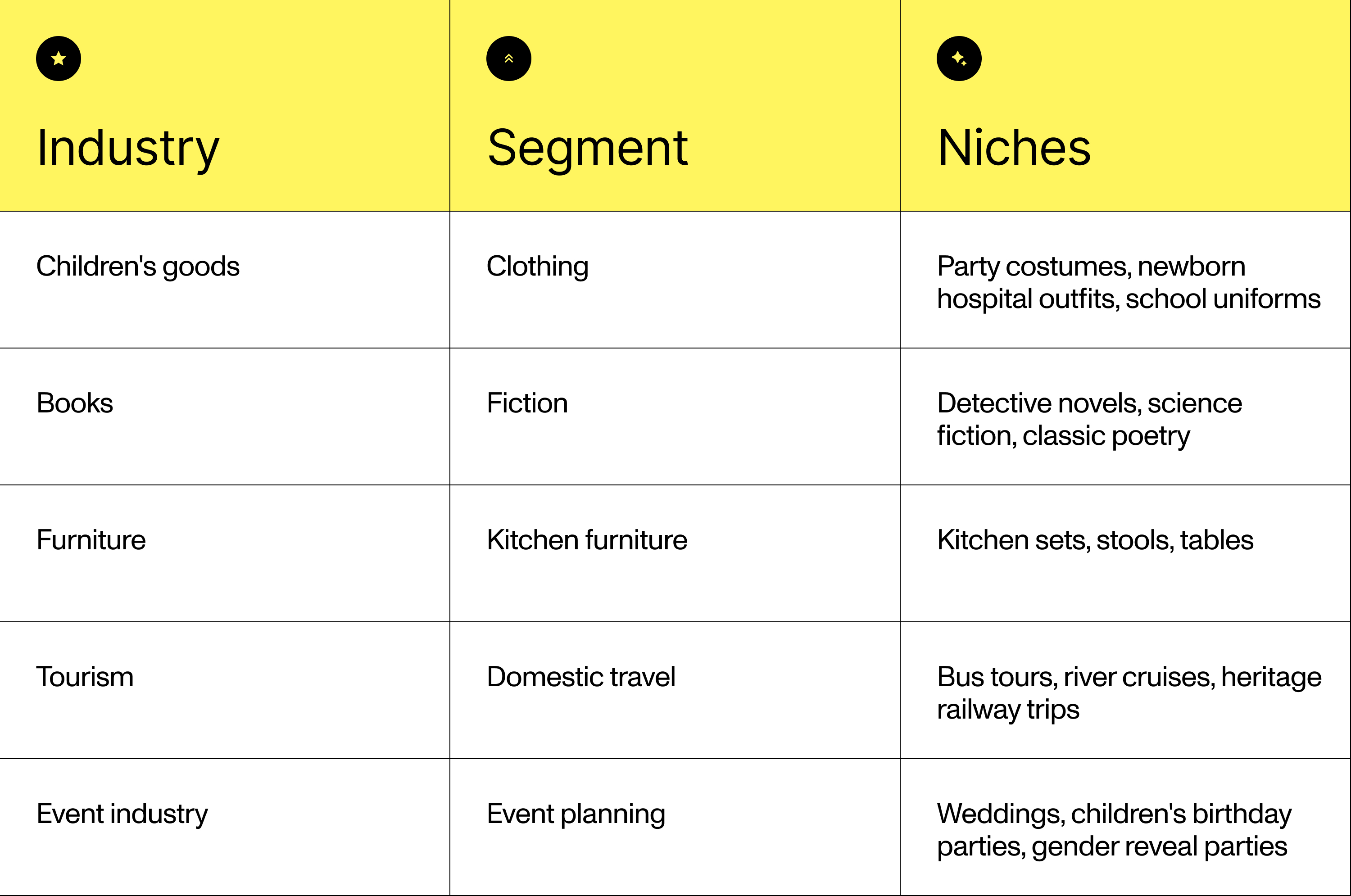
It is important to distinguish between a "niche" and a market "segment". A niche is a narrow, limited area within a segment, while a segment is a broader area within an industry. For example:
Types of Market Niches
Let's look at the main classifications.
By Niche Strategy
Target marketing. This involves focusing on very narrow market segments that are unattractive to large companies. It is characteristic of startups and sole traders (handmade jewelry sales, shoe repair).
A unique market situation. Due to a combination of circumstances, consumers may develop a unique demand for products that are absent or underrepresented on the market. For example, during a sports championship or music festival, branded merchandise with event symbols becomes highly relevant.
Horizontal marketing. A business focuses on one specific audience segment and tries to cover as many of its needs as possible. Wedding planners working on a turnkey basis operate this way: they handle venue selection, decor, emcee, photographer, and invitation dispatch.
Vertical marketing. A company works with different audience segments and "embeds" its product wherever it is relevant. For example, handcrafted wax candles can be distributed through bookstores, flower shops, massage studios, and spas.
Cluster (bundle) marketing. A business builds a loyal customer base and offers a full range of goods and services so customers can meet all their needs in one place. This is typical of men's barbershops: haircuts, beard grooming, grooming product retail. Some add manicures, waxing, and tattooing.
By Volume
Wide niches cover a variety of product/service categories. For example, a sewing notions store selling buttons, snap fasteners, zippers, buckles, hooks, ribbons, and trims.
Narrow niches are focused on a single product category or service type: Chinese tea, handmade greeting cards, commissioned portrait painting.
Expert comment:
Starting in a narrow niche — assuming there are clients, of course — is much easier than operating without any niche focus at all. This applies to small companies and individual specialists alike.
Our studio also works in a narrow niche: we produce only text content; we don't shoot video or photos, and we don't build websites. Does this limit our income? Definitely. Clients often prefer ordering services on a turnkey basis.
But for a young studio, such an expansion is uncomfortable for several reasons, including organizational and financial ones. In some cases we do take on visual and layout tasks, but that's not yet a mainstream offering — and a possible growth area for the future.
By Demand Stability
Seasonal niches. Demand fluctuates depending on the time of year: heaters are in demand in winter and bought less in summer. Fins for snorkeling, on the other hand, are relevant in the summer holiday season.
Evergreen niches. Products are in demand at all times; sales are not affected by seasonality. Examples: food, cosmetics, household supplies.
By Visibility
Visible niches include obvious products and services that people encounter in everyday life: food, clothing, kitchenware, furniture, cafes, gyms.
Hidden niches include less obvious products: spare parts, consumables, raw ingredients for homemade cosmetics.
By Geographic Reach
Local niches. The business is tied to a specific area (city, region): wedding planning in London, bespoke tailoring in Berlin.
Global niches. These involve a wide geographic reach. For example, handmade jewelry can be sold to customers in different cities and countries.
Advantages and Disadvantages of Niche Businesses
When a business specializes in a narrow segment and sells a specific product, it is called a niche business. Such areas typically feature very low competition and a small audience — for example, vinyl record sales, diving drysuits, or underground tour experiences.
Services like manicures might seem like a narrow niche, but the audience is broad and competition has intensified. A truly narrow niche could be a specific type of manicure, such as Japanese-style nail art.
Working in a niche field has its pros and cons.
Advantages
Customer loyalty. Due to limited or absent competition, consumers have fewer alternatives. They tend to buy from one seller and return for repeat purchases.
Lower marketing costs. Because the customer base is small, word-of-mouth often works well in niches: new buyers come through recommendations from people in the same target audience. The need to compete for clients is not as pressing, since there are few or no competitors on the market. As a result, niche companies require less spending on advertising and promotion than those operating in highly competitive markets with broad audiences.
Fast growth. In niche businesses, demand usually outpaces supply. This makes it possible to set above-market prices and rapidly grow sales and revenue.
Disadvantages
Limited scalability. Niches are hard to expand because demand and the target audience are narrow. These businesses tend to earn primarily through repeat customer sales rather than scaling.
Risk of demand decline. Consumer preferences can change at any moment. If demand for a niche product drops, the company may have nothing to offer — forcing it to adapt to new conditions and change its niche.
Possible increase in competition. Other companies may enter a free and promising niche. This complicates operations, requires additional advertising and promotion spend, and increases the risk of being displaced from the market.
How to Choose a Market Niche and Start Working in It
Let's look at the selection criteria, launch process, and common mistakes.
Selection Criteria
When choosing a niche, consider the following:
- demand — consumers need the product, and the company's offering is relevant to them;
- growth potential — the niche may become more relevant, in-demand, and profitable over time;
- low competition or none — there are few or no companies offering a similar product on the market;
- product uniqueness — the product or service stands out advantageously from competitors' offerings;
- expertise — the company's management and staff understand the chosen field and have the required knowledge and skills;
- resources — the company has the necessary means to operate: money, equipment, materials, and staff;
- personal interest — the business owners are passionate about the niche.
Launch Process
Research the market and competition. Choose a field you enjoy, understand, and have resources for. The following sites can help with finding business ideas: Trendwatching.com, Springwise.com, Trendhunter.com. It is also useful to explore crowdfunding platforms: Kickstarter, Indiegogo.
Analyze the market:
- Is there demand, how high is it, and is the niche promising?
- What factors could affect the market: seasonality, the economic and political environment, the target audience's financial situation, changes in legislation and taxation?
- How many companies are on the market, what are their strengths, how do they position themselves, and what products do they offer?
Ideally, a niche has high demand and limited supply: consumers need the product or service, but few providers offer it. Demand can be assessed using search query analysis tools such as Google Trends and Google Keyword Planner. The more commercial queries for relevant keywords, the higher the demand in the niche. To identify and analyze competitors, tools like Semrush, Ahrefs, or SpyFu can help.
Define and segment your target audience. Build a customer persona: gender, age, location, social and financial status, purchasing power, marital status, interests, preferences, needs, and pain points. Find out which current audience needs competitors are not addressing — these can become the focus of the business. To do this, gather feedback: conduct a survey or focus group, and learn what consumers want and what they currently lack.
Identify your strengths and weaknesses. SWOT analysis is great for this. It allows the company to identify competitive advantages, weaknesses, opportunities, and threats to the business. Based on the results, a USP (Unique Selling Proposition) can be created, development directions outlined, and ways to improve operations and fix shortcomings mapped out.
Develop a business plan. Describe the strategy for launching and promoting the product, marketing events, budgets, expected revenue, risks, and ways to resolve problems in case of setbacks.
Test the niche. Run a small-budget ad campaign in test mode, try selling a small batch of products or providing a service to a limited group of clients. Review the results: ad click-throughs, conversions, and sales volumes. If the results are good, continue in the same direction. If unsatisfactory, adjust the strategy, fix the shortcomings, and relaunch.
Common Mistakes
Launching without the required knowledge and skills. If a business owner does not understand the chosen field and has no experience in it, running the business and outperforming competitors will be difficult. It is best to choose familiar niches, and to thoroughly study unfamiliar ones before launch, bringing in experts and consultants as needed.
Lack of customer focus. When choosing a niche, it is important to consider not just personal interests and preferences, but also the needs of consumers. Otherwise, the company risks encountering low or absent demand.
Skipping market research. Without studying the market, competition, target audience, and conducting a SWOT analysis, the company is operating blindly. The risks of financial loss increase.
Skipping testing. Theoretical hypotheses need to be validated in practice. Without tests, there is a risk of entering a niche with no real demand, wasting time, money, and effort.
Choosing an uninteresting field. The business owner must have a personal interest in the chosen niche and genuine enthusiasm for it. This helps work more effectively and productively. If the owner is indifferent to their business, running it will be difficult and unrewarding.
Key Takeaways
- A market niche is a narrow area of business where the target audience is clearly defined and their needs are specific.
- Advantages of niches: target audience loyalty, reduced advertising and promotion costs, fast growth. Disadvantages: limited scalability, risks of increased competition and demand decline.
- To start in a niche, it is necessary to research the market, competition, and target audience; identify strengths and weaknesses; create a business plan; and test your choice.


.jpg)
.jpg)

.jpg)


Get in touch today to discuss how we can help your brand stay ahead
